tl;dr
I’m not a doomer: As I’ve said before, I believe in the potential of AI to transform the human experience for the better and think it will make work better as well. But I’m also worried about what happens to the Bay Area and Seattle when the jobs start going away before new ones get created.
Because of the high concentration of tech jobs in the Bay Area and Seattle the unemployment rate could increase by 2-10x.
That’s pretty dark which is why I wrote Stop Waiting for the Pause to try and understand what economists and policy makers think we can do to avoid that future.
Concentrating the mind
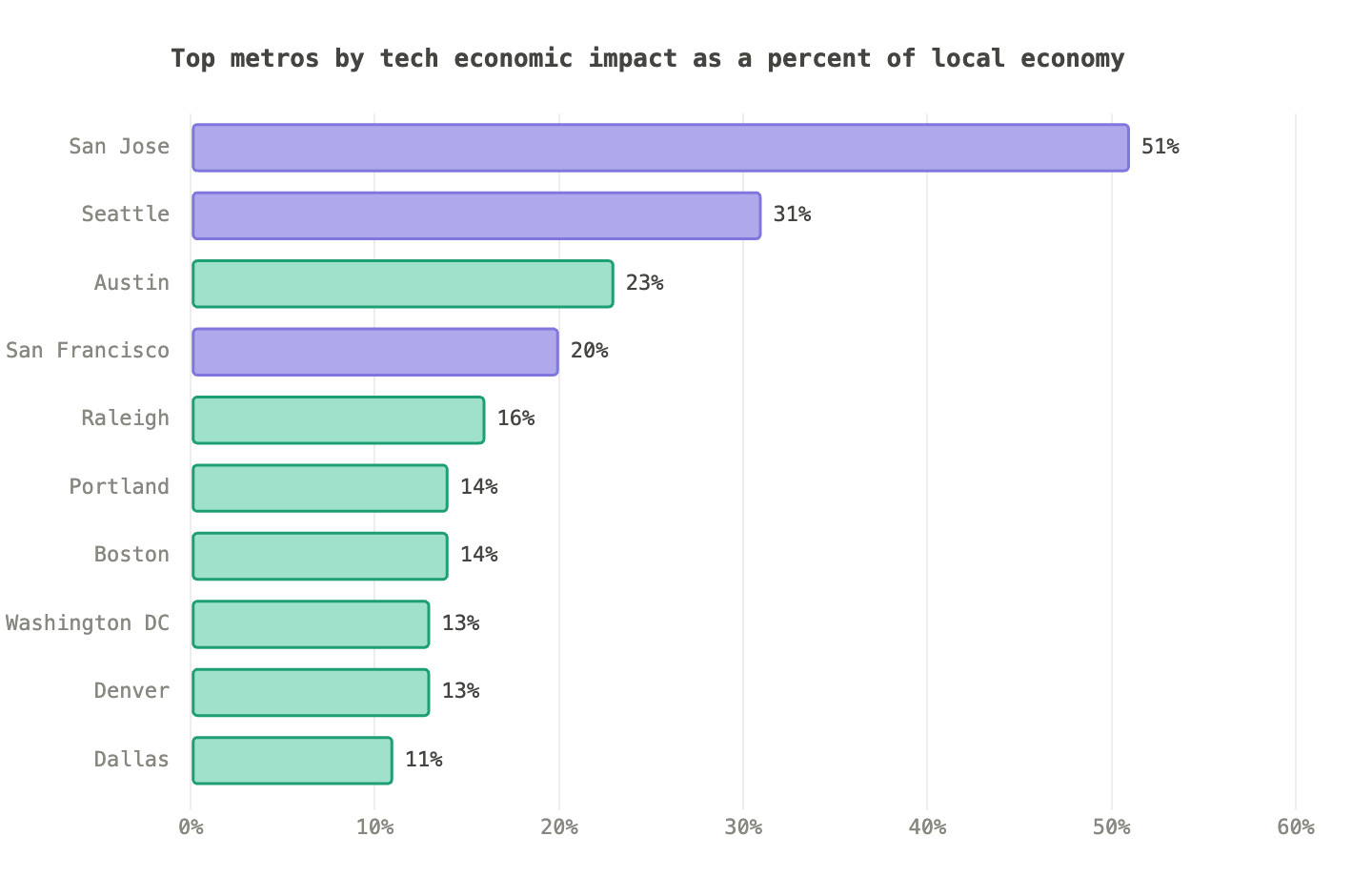
Most stats that get shared are country level averages. But we know that averages hide what’s happening and in this case smooth over painful spikes. Two reasons to pick the Bay Area and Seattle:
Concentration of tech jobs. On average only 5.8% people in the US are employed in tech. It’s 30% in the San Jose metro area. Given software engineering has the highest rate of AI agent adoption, these areas are ground zero for AI driven displacement.
Feelings. My family and I have spent 10 years living and working in the Bay Area and now Seattle so they are home and the people affected are friends and colleagues.
Scenarios
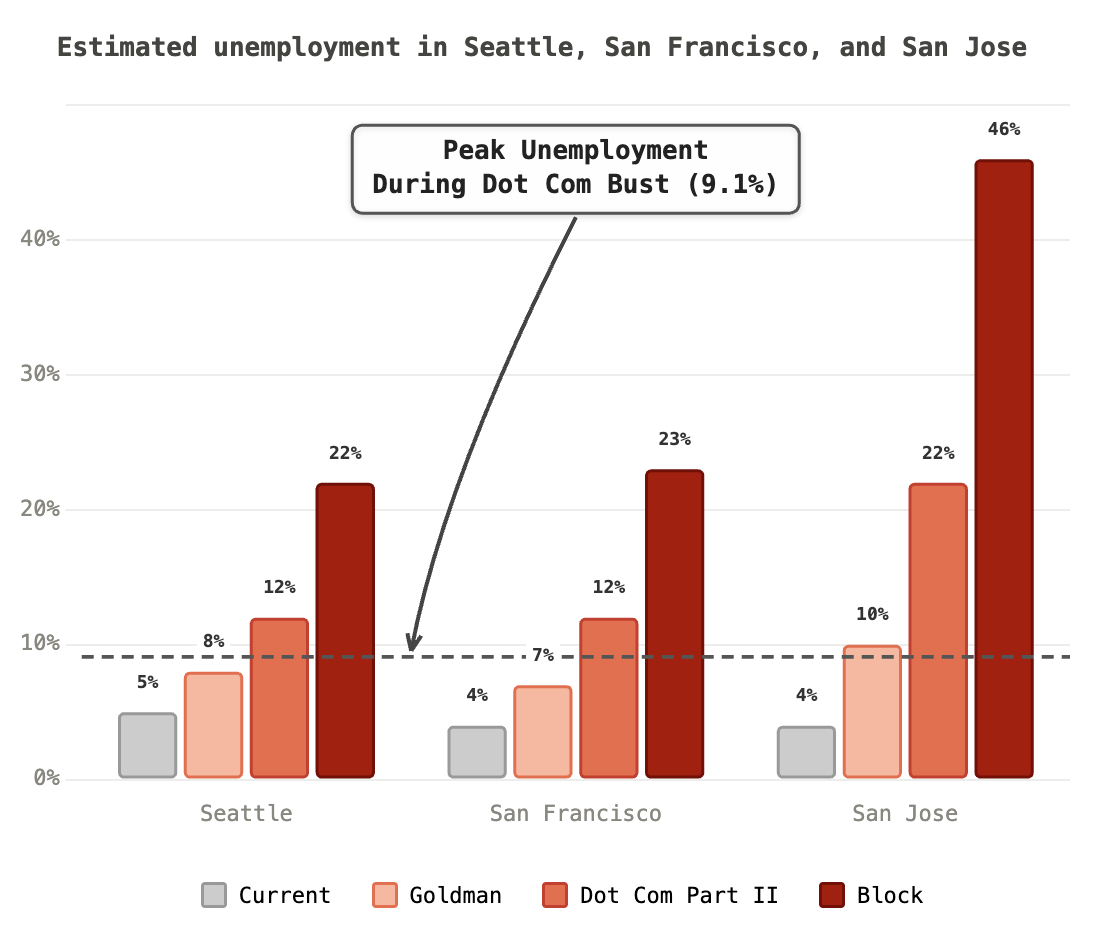
I’ve modeled three job displacement scenarios outlined below. While I’m using these scenarios as “low, medium, high” these are all terrible outcomes.

Goldman: 6% based on the Goldman Sachs report. This was their total displacement number over 10 years but I think it’s fair to use it as a shorter term estimate since we’re just focusing on tech, not a national average across multiple industries.
Dot Com Part II: 17% which was the peak unemployment rate in tech during the Dot Com Bust of the early 2000s.
Block: 40% assuming tech companies follow Block’s lead.
A criticism of this would be that AI driven productivity hasn’t shown up and/or AI will create new jobs and industries (link). Three counterpoints:
The future is unevenly distributed right now. At Anthropic, they are estimating a productivity increase of ~4x on the high end (link). Other companies that are not all-in and have existing operations will take time to fully automate through large, complex, Top Down projects.
Jobs listings for Software Engineers are down 30%+ based on analysis from Indeed (link).
Pressure to act first. Just because companies haven’t realized efficiencies yet doesn’t mean they won’t cut - especially if they think it can accelerate the transition. That was the case for Meta and Block which not yet realized efficiency gains from AI but saw a path to cut 10% and 40% of staff, rewire along the way, and still grow (see the The Great Rewiring). For Meta, this helped fund massive investments in AI. For Block, this helped increase their stock price ~30%.
All this to say, I think there’s credible evidence for downward pressure on jobs in the short term.
Economic impact
We’ll look at the economic impact along three dimensions: Unemployment, Commercial Vacancies, and Housing Prices.
Unemployment
Using data on the number of tech jobs in each of the metro areas and the three scenarios above we can estimate the number of lost jobs in tech. But that’s just the start.
UC Berkeley economist Enrico Moretti estimates that each high tech job creates 5 indirect jobs in services (e.g. lawyers, teachers, nurses, waiters, hairdressers, carpenters).
When the high tech jobs go away, these jobs are impacted too. Not all 5 of the services jobs will be displaced as some jobs like teachers and nurses are not immediately affected by a contraction in discretionary spending (though they will be in the long term as population shifts). Let’s assume that 2.5 of the 5 of the downstream jobs will be impacted.
A simple model tying all the numbers together is here and summarized in chart. The most conservative scenario would lead to unemployment matching the Dot Com Bust. The worst case would see unemployment 10x.
Commercial Space
During the Dot Com Bust office rents fell as vacancies soared to 25% in SF.
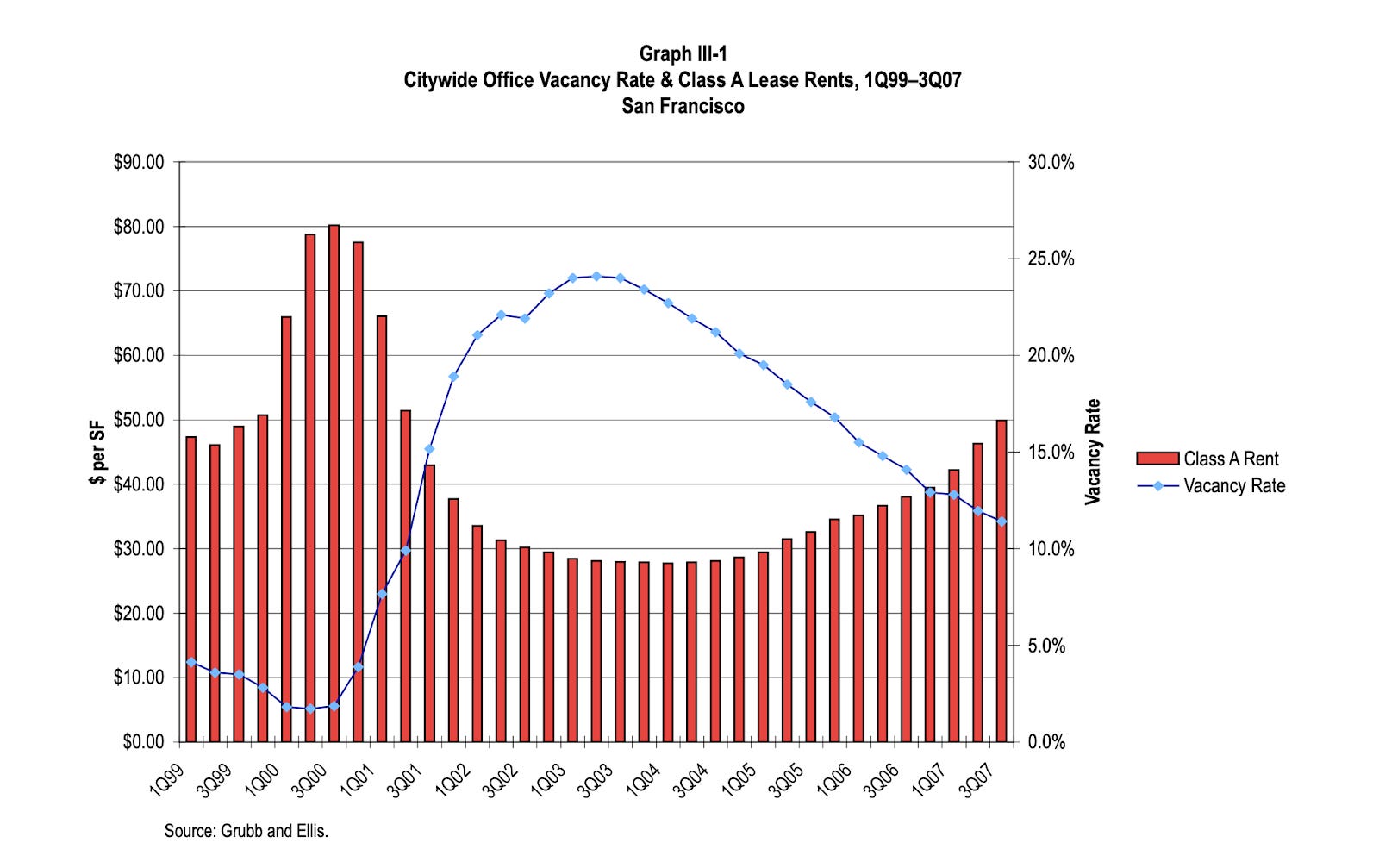
While they eventually recovered, vacancies increased again during COVID and sit today at 30% in SF and 23% in Seattle (link, link) - that’s higher than the peak of the Dot Com Bust! Higher unemployment would increase vacancies further and rates of 40-50% would lead to delinquency and default without intervention.
Housing prices
The story on housing in the Bay Area during the Dot Com Bust was more nuanced. From Zillow:
“Home values in the top third of the market fell 9.5 percent in San Jose and by 3.8 percent in San Francisco between May 2001 and January 2002. Home values in the bottom third fell 3.8 percent in San Jose, and actually increased by 4.8 percent in San Francisco.” (Zillow)
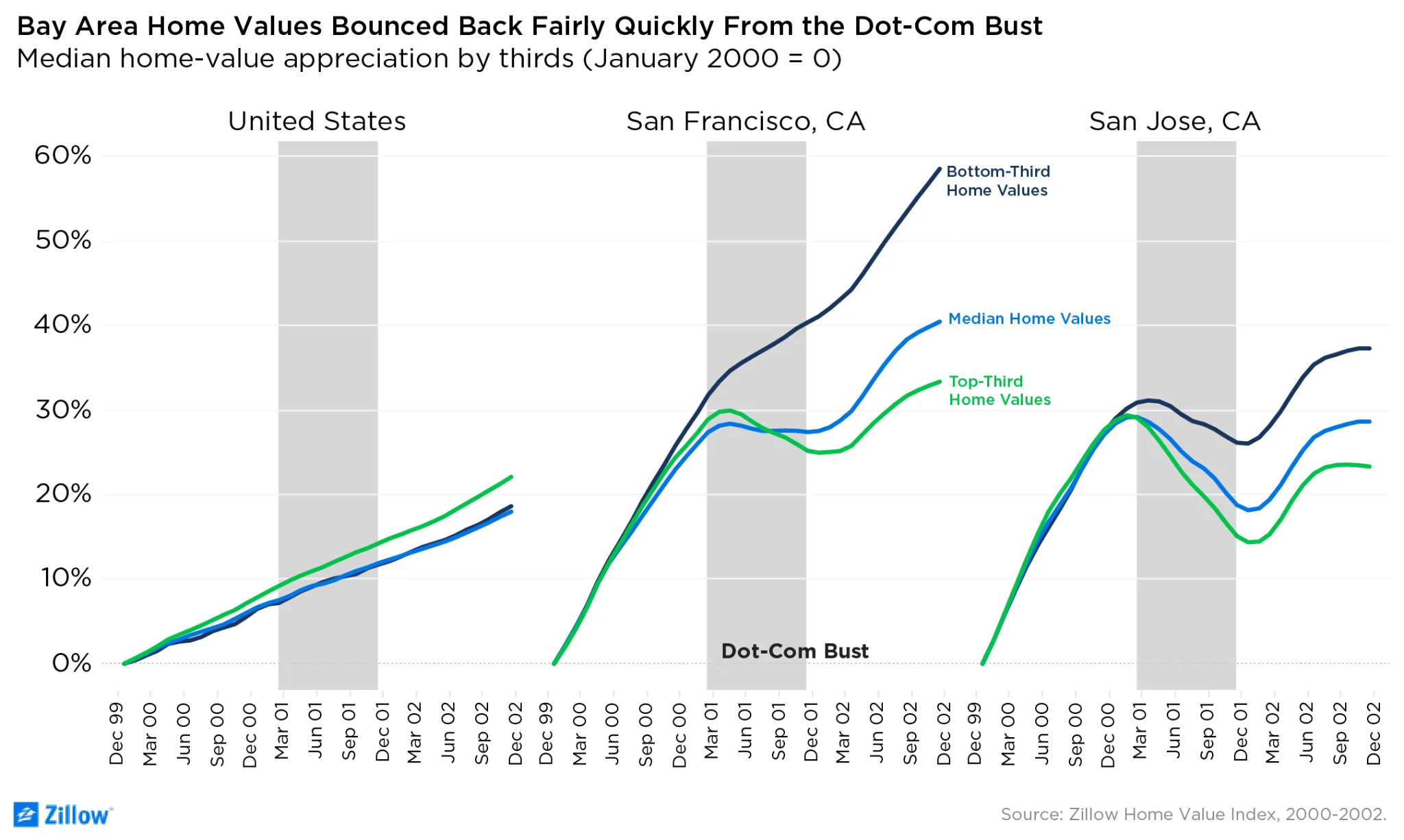
That there is so little housing stock in the Bay Area helps prop up prices compared to Seattle. It’s not clear the we would see the same pattern today - interest rates are higher, inflation is still a concern, and the total unemployment rate would be higher in any scenario more aggressive than Goldman’s.
What this might look like
It is tempting to compare this to the Dot Com Bust which I’ve referenced several times. The Goldman scenario leads to a similar net unemployment rate and we’ve seen how the industry can recover and grow again. The difference is that in 2001 there was no structural change. Yes there was a bubble, exuberance, and jobs disappeared but the Bay Area remained a dynamic place to start and build businesses. In this case, jobs will be going away because not as many people are needed and companies can run leaner, faster. The Bay Area may still be a good place to start and build businesses but fewer people will be needed to run them in the short term.
A better comparison would be what happened to manufacturing in the Rust Belt starting in the 1980s. Structural changes - increased foreign competition, factories closing here and opening in Asia - meant that not as many people were needed at manufacturers. Today, there are half as many jobs in manufacturing and many of the communities with the highest concentration of manufacturing jobs were devastated (link).
To avoid a repeat in different regions and a different sector, let’s focus on what we need to do about it.