Bolt-on progress
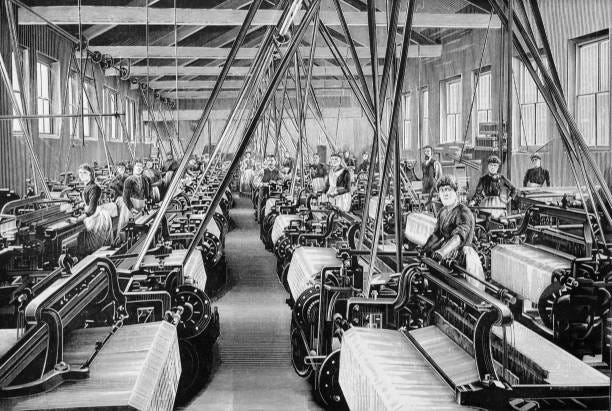
When electrical motors were first developed, factory operators made the very logical decision to keep their factories largely the same but just replace their old engines (water, steam, diesel) with a big electrical motor. This was a simple substitution that gave them some benefits in terms of predictability and total available power.
But it didn’t change the complexity of how their factories were organized:
And zooming out a bit more:
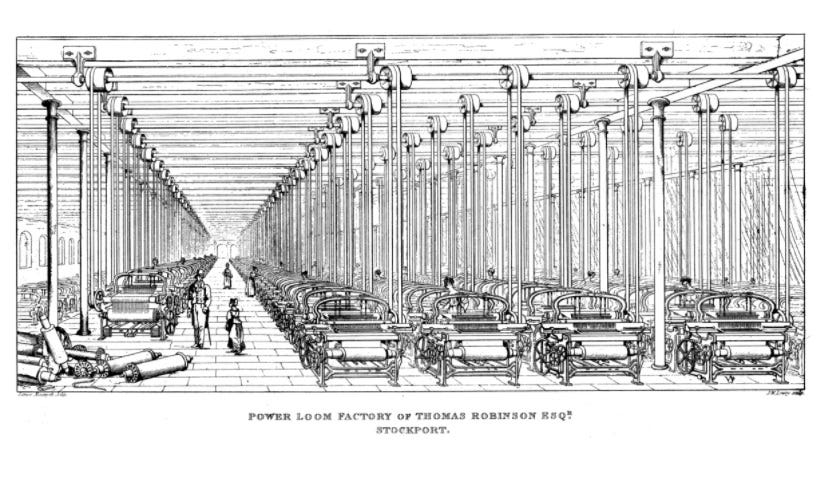
Powered axels ran the length of the factory, driving a nest of belts and wheels that in turn ran the machines. Clutches would move the belt to an idler if the machine was not needed or more power was needed elsewhere.
Of course, factories look nothing like this today because eventually individual motors were placed in each one of the machines. This innovation allowed companies to eliminate the complex nest of axels and belts, reorganize their factories, and optimize material flow.
Post-AI organizational design
Today, companies look a lot like those old factories except that instead of the axles and belts we have a nest of teams, meetings, chat messages, emails, and other lossy connections that are required to build and ship products.
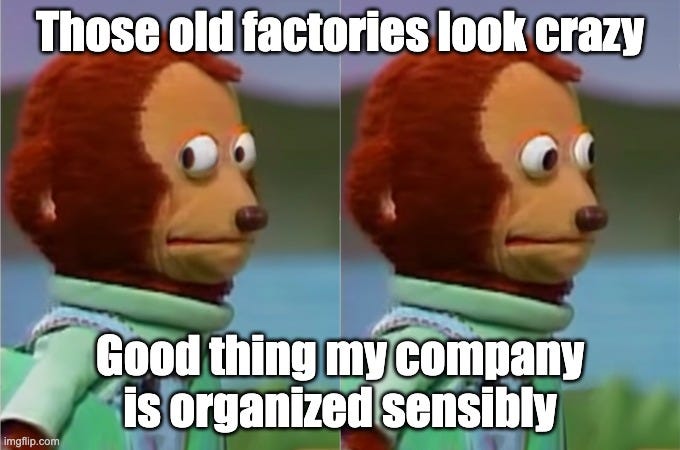
We’ve bolted on AI by giving ChatGPT/Claude/Gemini to each employee and telling them to figure it out. (And by the way if you don’t figure it out, you’ll get dinged on your perf.).
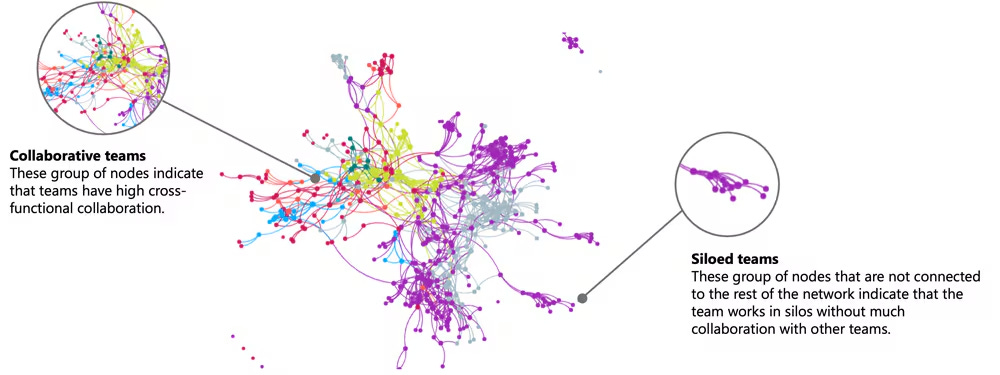
This limits the power and potential of AI because we haven’t changed how we organize work. All of the old axels and belts are in place and an an employee who uses Claude to draft an email, a piece of content, or new piece of code still has to push it through an organization that looks a lot like that old factory:
Why this means less jobs
What we are seeing is that fewer people will be required to design, ship, sell, and support products because with AI one person is doing not just more work, but work that was historically done by different functions. (See my previous article)
For a product manager that understands architecture, what is the benefit of extended back and forth with an engineer to build a product? For an engineer with strong product sense, what is the benefit of working with a PM to build a product?
A VP of Engineering I spoke with described the change as “PMs shifting right while engineers are shifting left”. A CTO described a new role that we’re just going to call “Product Builder.”
The same will happen for specialist roles like legal: Anthropic already uses a system they built in-house to automate legal review (link). The same will happen for roles that require taste: Google has shipped Stitch to enable people to “vibe design” (link).
If you can reduce the number of unnecessary nodes in a system you reduce its complexity and increase its velocity. Reducing nodes is a brute force approach and still doesn’t get at the reorgnaization of the “factory floor” for knowledge work that is needed.
What it will look like
The feeling in the pit of our stomach when we see photos of old factories is the same feeling we will get when we look back at how we work today.
That nest of lossy connections of chats/emails/docs/meetings will be replaced with AI systems that enable efficient coordination across larger groups. Every employee will have their own AI Chief of Staff organizing their work, fielding the stream of pings asking for status updates, asking how something works, where that file is, freeing them for the work that actually matters. Meetings will get smaller, more productive, and worth showing up to.
I’ve been spending a lot of time talking to people that are trying to figure out what that new factory floor looks like at big companies and startups. It’s still very much a work in progress with lots of pain points but there are some early learnings which I’ll share in a follow-up post.