The debate about the time and scope of AI driven job displacement is a distraction. Whether it’s 2 years or 4 years, 10% or 25%, it doesn’t matter because the direction of travel is clear: fewer jobs, economic hardship, and a government unprepared for what’s coming.
If we know the steamroller is coming, let’s move our feet. Or we look like this guy:


My priors
This article will spend time talking about the downsides because those are problems we need to focus on and solve, but I believe that AI will transform humanity for the better.
It’s easy to see why: if you have 10x, 100x, 1000x more intelligence focused on solving humanity’s greatest challenges - health, energy, climate - we will make more progress faster. For those still skeptical that this technology represents intelligence that can make those sorts of contributions, you’ve got to challenge your assumptions. Dario’s piece does a good job laying out what that world could look like.
But we’ve got to struggle through to get there.
Fewer jobs (in the short term)
This is be self evident to people that have worked with the tech but a few data points:
Layoffs across medium to large technology companies. Block at 40%, Atlassian 10%, Meta reportedly getting ready for 20%.
Philosophy of “talent dense” teams at startups. Translation: “We have been Claude pilled and need fewer people to get things done.”
Slower / no hiring for specific roles. “We are increasing the scope of responsibilities for existing people because it’s possible for them to get more done.” “There is no need to ever hire someone with the words ‘Content’ in their title ever again.” This is what I hear from startup execs across verticals.
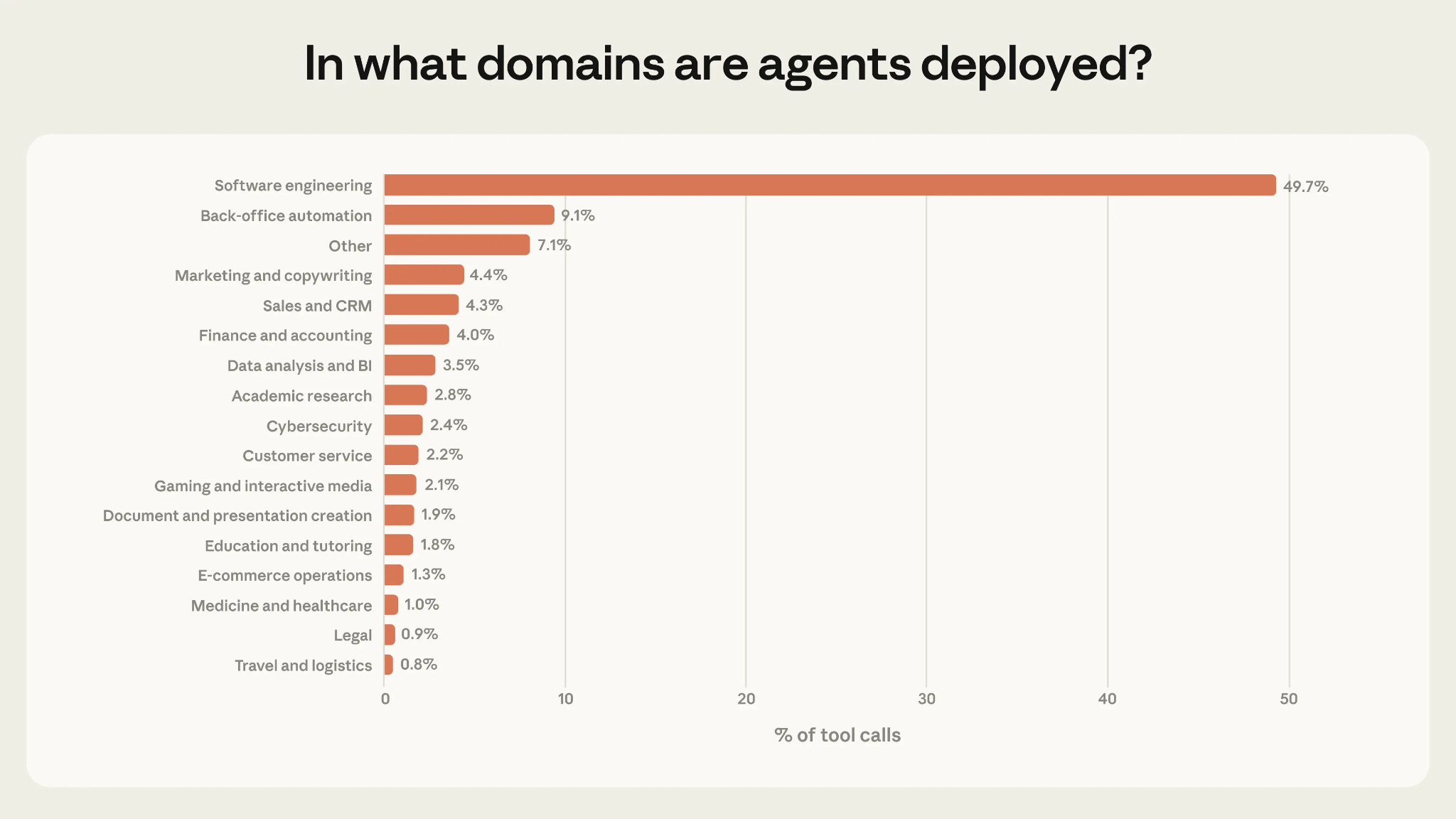
Tech is first and the rest of knowledge work will follow. This chart from Anthropic was getting shared around as inspiration to entrepreneurs to find the next great vertical SaaS AI opportunity. But it’s also the roadmap of which tasks and industries that will be hit after software engineering and tech.
Economic hardship
I’m going to do a deep dive on economic hardship in a later post so here I’ll focus just on lost wages. Goldman Sachs seems to land in between “We’re Doomed Citrini” and “Nothing to See Here Citadel.” Goldman says 6-7% of jobs will be displaced over a decade leading to an unemployment rate that is 0.6% higher than today. “But if it’s more frontloaded, the impacts on the economy are much larger.” Notably Goldman did not provide a high end number if it was frontloaded. That’s ominous.
Let’s say unemployment goes up between 0.6% and 1.8% on a working population of 162.9M (BLS) which puts between 997k and 2.9M people out of work. The initial impact will be highest on white collar workers with average income of $68k ($32.69/hr * 2080 hours per year).
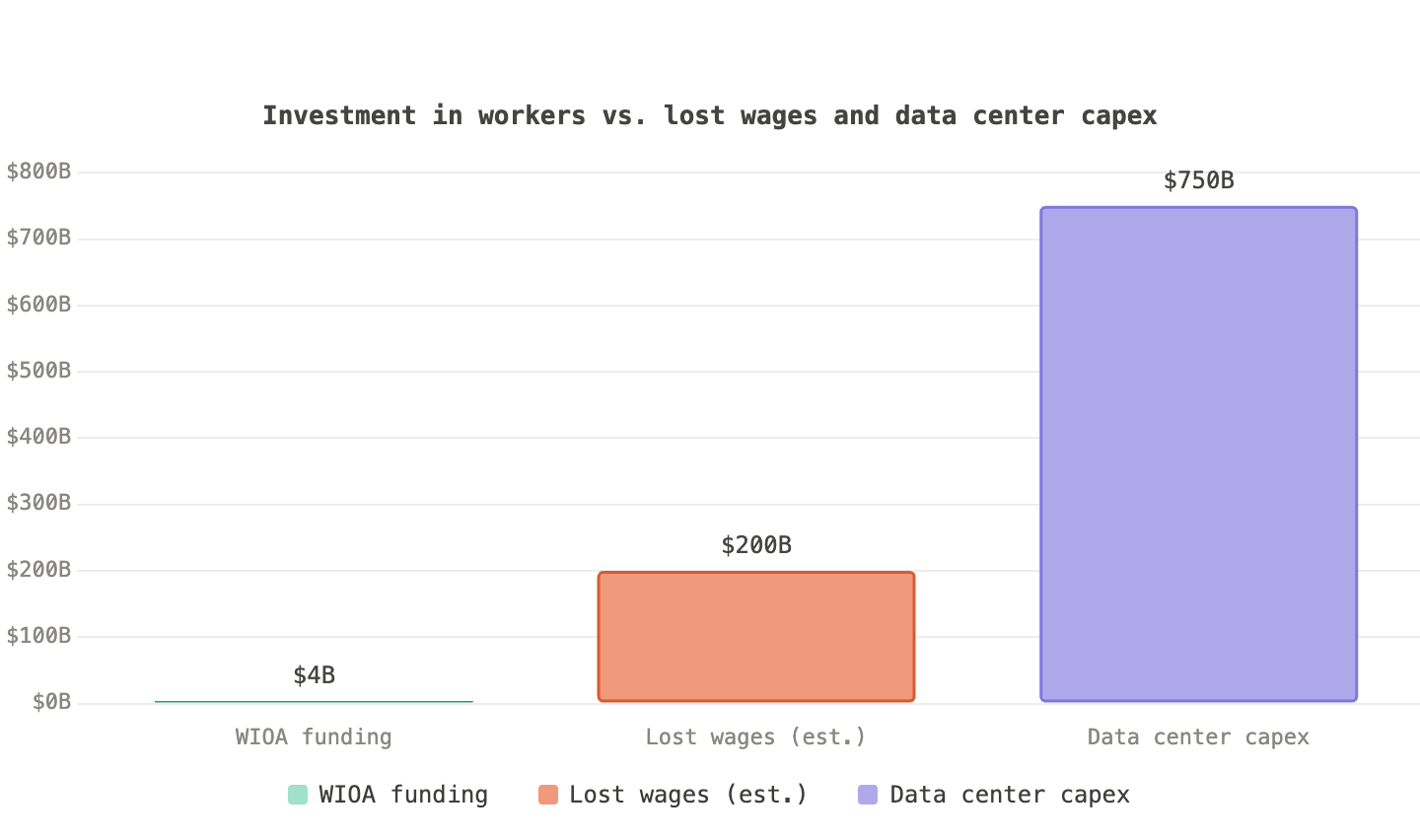
Total lost wages then will be between $66B and $200B.
That’s just lost wages, it doesn’t take into account the downstream effects of lost wages on services businesses, housing, cars, travel, etc.
Current funding to mitigate job displacement is a rounding error
In 2025 there was ~$4B in funding for jobs training and displacement support through the WIOA programs (link). It’s not enough and that number is set to shrink:
That’s 2% of the $200B in lost wages
That’s 0.5% of the planned $750B in data center capex this year (link)
The Administration actually proposed reducing the WIOA budget from $4B to $3B (link)
As a country we are investing at an unbelievable rate to win the AI race (which we should continue to do) but are failing to invest in what may be the largest worker dislocation in human history.
Activity over accomplishment
Our elected officials are not working together to address the problem. Since 2023, over 250 federal bills related to AI have been introduced. Only 2 have become law (link):
Take it Down Act. Criminalizes non-consensual intimate imagery including those from deepfakes. This is good, common sense legislation and focuses correctly on harms. (And should have been a law a long time ago)
One Big Beautiful Bill Act. Funding for the government to adopt AI across Department of War, Department of Commerce, etc. No focus on mitigating impacts of job displacement.
Chat GPT was released in November 2022. More than 3 years there is zero federal response to address jobs displacement.
What to do
It is critical that the US stay ahead in the AI race. But right now we're making the steamroller bigger and cutting the budget for the people in its path. Let’s figure out how to get them out of its way.