Stages of AI Adoption
Companies are racing to adopt AI, but they are shooting first and asking questions later.
My last post described how Block laid off 40% of employees without knowing the target structure. Meta may have done the same - some engineers who survived the layoffs are treading water for a month until the new AI org they’re joining is established.
To help make sense of the chaos and figure out what might happen next, we can organize companies by the stage of their AI adoption:
Stage 0: BYO AI. Employees use their personal ChatGPT / Claude / Gemini accounts for company work. The obvious business risk has propelled the “AI Chat for Business” offerings of OpenAI, Anthropic, Google, and Microsoft.
Stage 1: Bolt-on. Company signs an enterprise-wide license for AI Chat. Engineering gets access to Claude Code / Antigravity / Cursor / Copilot.
Stage 2: Individual productivity. Company establishes clear expectations and procedures for employees to improve their productivity. For Operations, this might look like a requirement to use a Legal Review or Marketing Copy review GPT / Gem / Skill. For Engineering, this might look like a Claude code rig that has all of the company’s conventions, style guides, and skills to make development easier and more consistent.
Stage 3: Company productivity. Company identifies and automates existing business processes with AI to improve speed and efficiency. This could look like Netflix leveraging AI to localize content with subtitles reducing the need for human translators, editors (link).
Stage 4: Rewiring work. This is truly reorganizing the factory. While still taking shape, this stage has a few hallmarks:
a) AI assistants serve as proactive helpers vs. reactive tools (Microsoft’s Scout, Workspace AI Chief of Staff)
b) Organizational intelligence enables individuals and leaders to get real-time vs. a status email on Friday afternoon or having to ping someone (Workspace Intelligence), and
c) AI agents take on significant scope from existing functions, increasing speed and reducing coordination costs. Think software test development, UI design for internal tools, or legal review for standard documents.
Frameworks and the Future
Frameworks are helpful to understand behavior and predict what will happen. Some observations about what this means for companies as they move up through these stages:
Businesses get more efficient
At Stage 1, the company incurs more cost by paying for AI tools and likely sees little gains due to inconsistent usage. At Stage 3, meaningful work is automated and the company is more efficient.
Potential for AI driven job displacement increases
As entire workflows are automated, companies will either need fewer workers or will hire more slowly than they otherwise would have. Staff can be redeployed, but that’s still pushing the headcount curve down. Freed up staff can start new lines of business, but starting and growing new businesses is really hard.
Adoption relies less on individual employee actions
In Stages 1 and 2, individuals have to decide how and when to use the tools they are given. In Stages 3 and 4, the company decides, the project is deployed, and the company benefits.
Companies that reduce coordination tax run faster
To understand why, take this thought exercise from Apenwarr:
Every layer of approval makes a process 10x slower…
Just to be clear, we’re counting “wall clock time” here rather than effort. Almost all the extra time is spent sitting and waiting.
Look:
Code a simple bug fix
30 minutesGet it code reviewed by the peer next to you
300 minutes → 5 hours → half a dayGet a design doc approved by your architects team first
50 hours → about a weekGet it on some other team’s calendar to do all that
(for example, if a customer requests a feature)
500 hours → 12 weeks → one fiscal quarter
For a non-Engineering example, imagine a company that has deployed a Press Release Review Agent that automates Comms and Legal review for product announcements. If you are launching a product, you submit your Press Release, get suggested edits back in seconds, make your changes, resubmit, and you’re done. All that took was 30 minutes rather than 1 week iterating with two teams.

I wrote about this in Rearranging the Factory:
“What we are seeing is that fewer people will be required to design, ship, sell, and support products because with AI, one person is doing not just more work, but work that was historically done by different functions.”
Flatter, Leaner Companies with Fewer Jobs
All of this points to a future with smaller companies and fewer jobs (at least in the short term), which has not been lost on anyone. This will be true at new companies that do more with fewer people, run a leaner cost structure, operate faster than larger companies. Larger companies are racing to reorganize to compete. (See e.g. Microsoft’s rebuild).

ICE and Boos
The perception that AI is coming for our jobs has made AI deeply unpopular. In a recent NBC poll, AI was less popular than ICE (U.S. Immigration and Customs Enforcement) with a net -20 approval rating vs ICE’s -18 (NBC News).
Young people graduating college have yet to experience their first re-org but see where this is going. Which is why when their commencement speakers talked about AI, they booed. Watch this supercut of the 2026 graduating class saying what they think of AI in the workplace.
This perception matters because the backlash will limit AI adoption in Stages 0 to 2, which rely on individuals to work differently. This makes the business case for using AI in these stages very tenuous because companies will be paying for both employees and AI, all while seeing only marginal gains.
As a result, companies will move as quickly as they can to Stage 3 and 4 to automate more work, limit what they pay employees, and fund AI budgets.
Bring in the Consultants
Making changes of that scale at a company while still running the underlying business is very hard. And this is exactly why companies are hiring consultants.
In the early ChatGPT days, you might remember the predicted end of consultancies like BCG, McKinsey, and Bain. Rather than shrinking, consultancies are growing faster than they have in years because not only are they good at analyzing large volumes of information, they are also good at reorganizing companies and driving change. BCG reported that over 40% of its revenue is now coming from AI and tech-focused services (link).
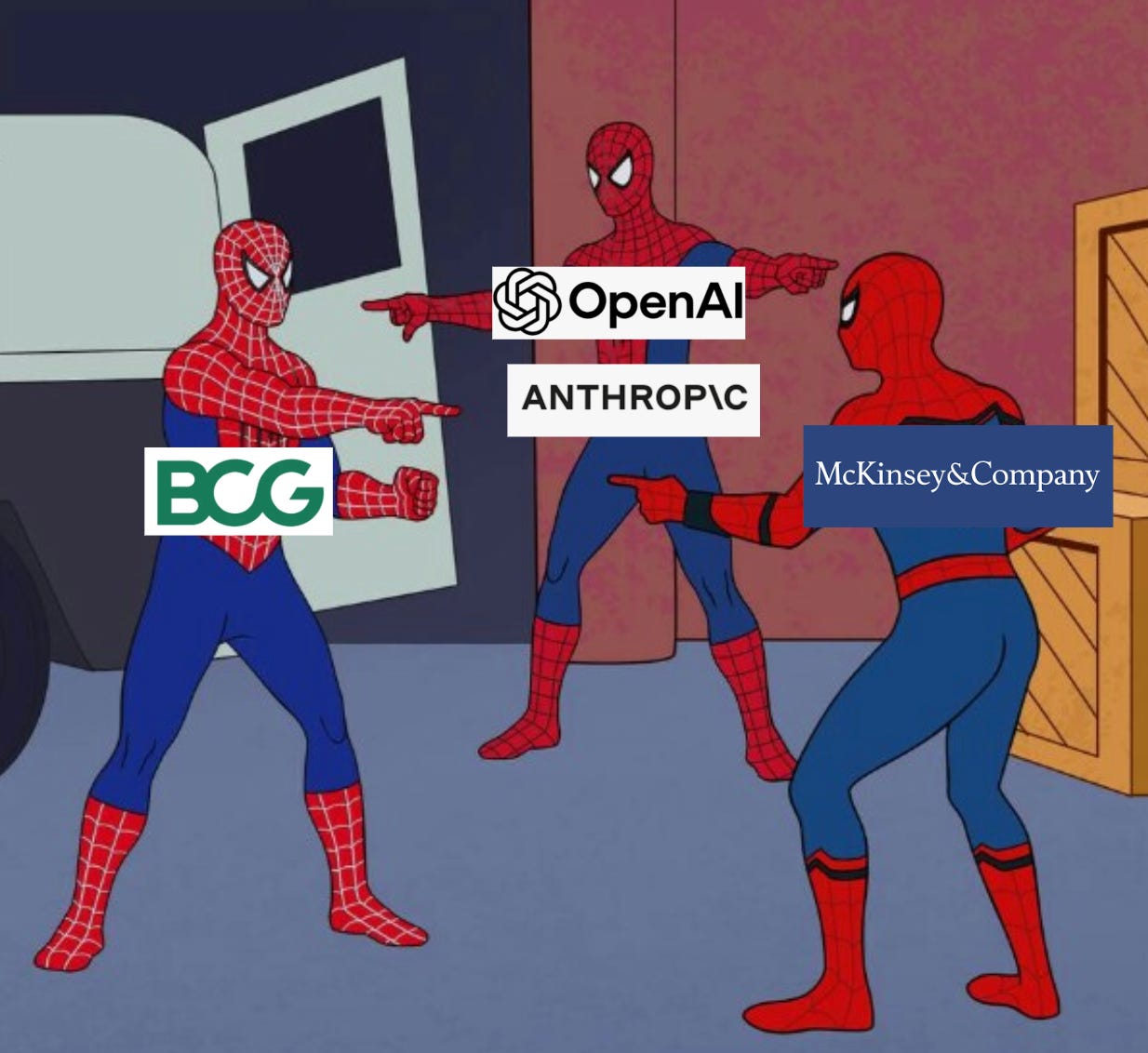
In addition to the traditional firms, you see both OpenAI and Anthropic launching consultancies. They call them “Forward Deployed Engineering teams” instead of “Client Teams” but the goal is the same: Help companies get to Stage 3 and 4 - and as soon as possible.
Jobs “J Curve”
All of this points to fewer jobs in the short-term. Eventually capital will be re-deployed, AI will make it easier for those with the desire to start a company, and new industries will grow. But in the interim, it’s going to look like a “J curve” with job losses before we come out the other side.
Next week I’ll be releasing two posts at the same time, a view of what happens to tech heavy employment metros like the Bay Area and Seattle when this J curve starts.